

Why Families Commission Portraits Instead of Photographs
- thibaultbarrere

- Mar 25
- 4 min read

In an age where cameras are everywhere and millions of photographs are taken every day, one might wonder why families still choose to commission painted portraits.
After all, a photograph can capture a face instantly.
And yet, throughout history (and even today) families, institutions, and collectors continue to commission portraits from painters. The reason lies in something deeper than simple representation.
A painted portrait is not merely an image. It is an interpretation, a legacy, and often one of the most meaningful works of art a family will ever own.
Portraiture as a Record of Legacy
For centuries, portraits have served as visual records of individuals whose lives and presence mattered to those around them.
Many of the portraits we admire in museums today were originally created for families who wished to preserve their image for future generations. The tradition can be seen in the works of artists such as Anthony van Dyck, whose portraits of aristocratic families defined elegance and lineage, or Diego Velázquez, whose court portraits became enduring symbols of an era.
Later, painters like John Singer Sargent carried this tradition into the modern world, capturing the personalities and presence of prominent families in Europe and the United States.
These paintings were not created simply to decorate a wall. They were intended to become part of a family’s visual history.
In many homes today, portraits of grandparents, founders, or important ancestors still occupy a central place, quietly linking past and present.
Interpretation Rather Than Documentation
The most fundamental difference between a photograph and a portrait painting lies in the role of the artist.
A photograph records a moment in time. A painter studies a person over hours, sometimes days, observing how they move, how they sit, and how their expression changes in conversation or thought.
Through this process, the artist begins to understand not only the sitter’s appearance but also something of their character.
The portrait that emerges is therefore not simply a snapshot. It is a considered image, shaped by observation and artistic judgment.
This is why painted portraits often feel more timeless. They represent not just how someone looked in a particular second, but how they appeared in a broader sense—how they carried themselves, how they inhabited a room.
The Presence of the Artist’s Hand
Another important distinction lies in the physical nature of the painting itself.
An oil portrait is built slowly, layer by layer. Every brushstroke reflects a decision: how light falls across the face, how color shifts within the skin, how posture conveys personality.
The result is a work that carries visible traces of the artist’s hand and attention.
This quality gives painted portraits a sense of presence that is difficult to replicate in mechanical images. Standing before a portrait, one often feels that the sitter occupies the space in a way that photographs rarely achieve.
The Experience of Sitting for a Portrait
For many families, commissioning a portrait is not only about the final painting but also about the experience itself.
Sittings allow the artist to observe the subject directly, often over several sessions. During this time, conversation unfolds naturally. The sitter relaxes, gestures, and expresses themselves in ways that reveal subtle aspects of personality.
This interaction creates a connection between artist and sitter that becomes part of the portrait’s history.
Long after the painting is finished, families often remember the process itself as a meaningful moment,
the time when the portrait was created.
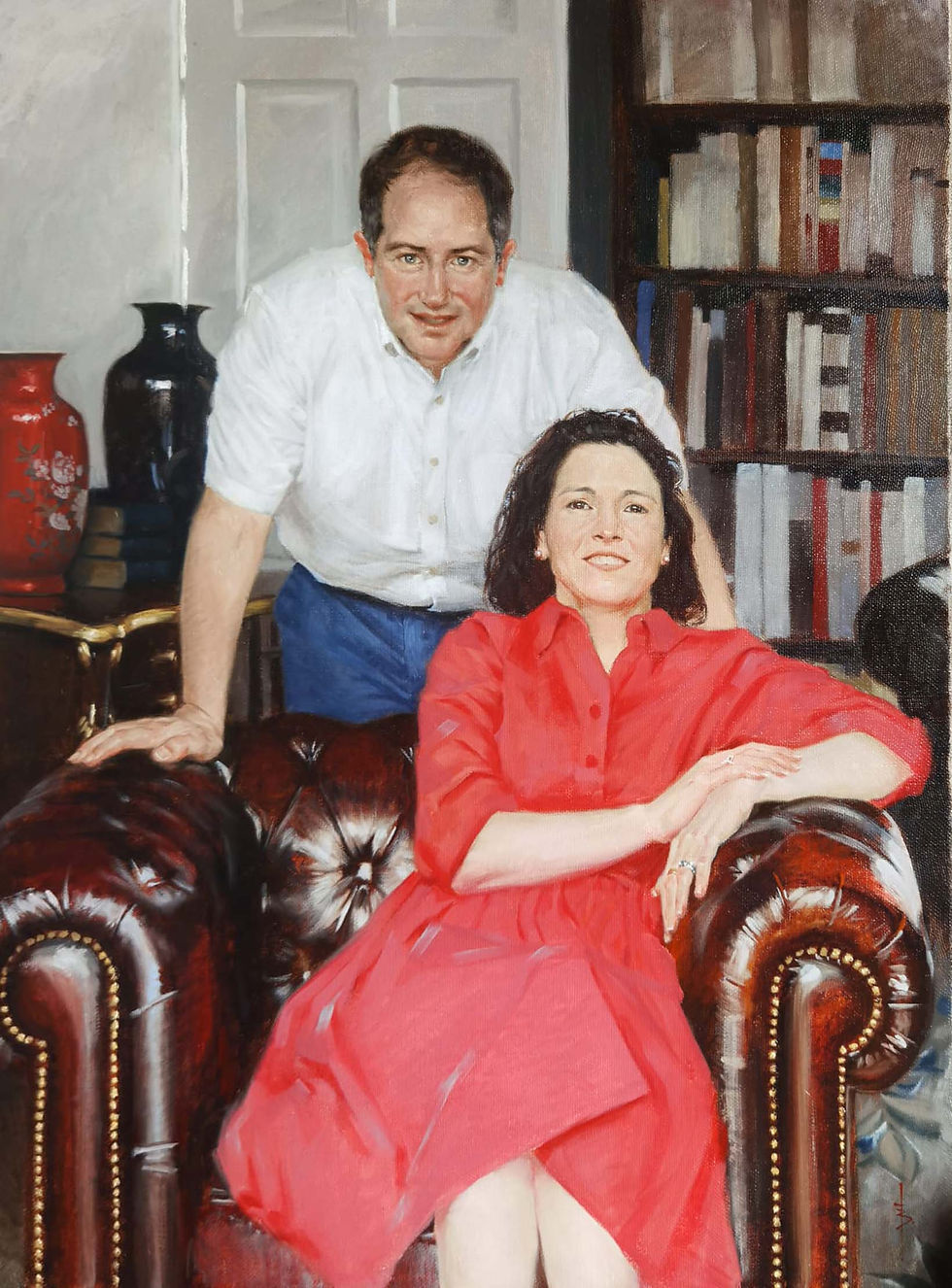
Portraits as Family Heirlooms
Photographs tend to accumulate in large numbers and are easily forgotten in digital archives. Portraits, by contrast, occupy a singular place within a home.
Because of the time and care involved in their creation, portraits often become focal points in a family’s collection. They are objects meant to endure physically and emotionally.
Over time, they acquire additional layers of meaning. Children grow up seeing them on the walls; later generations inherit them along with the stories attached to them.
In this way, a portrait becomes something more than a representation. It becomes part of a family’s narrative.

A Tradition That Continues
Despite the technological changes of the modern world, the tradition of portrait painting has never disappeared.
Families still commission portraits to mark important moments, celebrate achievements, and preserve the image of those they hold dear.
Just as patrons once commissioned artists like Anthony van Dyck or John Singer Sargent to record their presence for posterity, collectors today continue to value the unique ability of painted portraiture to capture both likeness and character.
A photograph can document a moment.
A portrait, however, has the power to preserve a presence, and to carry that presence forward for generations yet to come.
Portraits have long served as a way to preserve the presence of individuals whose lives and stories matter deeply to those around them. For families interested in creating a portrait that will remain part of their history for generations, commissioning a painting offers a uniquely personal way to preserve that legacy. Those considering a portrait commission are always welcome to inquire about the process.


Comments